
Everything you need to know
before you go
Entry requirements, best time to visit, budget, currency, getting around, phone data, safety, and the practical details that make Anguilla easier to enjoy once you arrive.
What you need
to enter Anguilla
Anguilla is a British Overseas Territory, but it has its own entry rules. For most North American travelers, entry is straightforward: you need a valid passport, a return or onward ticket, and the usual travel details showing where you will be staying.
Passport. A valid passport is required for all visitors, including U.S. and Canadian citizens. Official U.S. guidance lists passport validity as required at time of entry, while Anguilla tourism guidance recommends that your passport be valid beyond your intended departure date — travel with a passport that comfortably covers your full trip.
Visa. U.S. and Canadian citizens generally do not need a tourist visa for short visits to Anguilla. Travelers from other countries should check official requirements before departure, especially if connecting through another country on the way.
UK ETA. A UK ETA is not currently listed as a standard requirement for travelers entering Anguilla directly. The UK ETA applies to travel to or through the United Kingdom in specific situations, not automatically to every British Overseas Territory trip. If your itinerary connects through the UK and you pass through UK border control, check UK ETA rules separately before flying.
Departure tax and port fees may apply when leaving Anguilla by ferry or air, and they are not always included in the price you first see online. If you are arriving through St Martin and taking the ferry, budget for the ferry ticket plus separate local fees.
- Valid passport (valid beyond your intended departure date)
- Return or onward ticket
- Proof of accommodation may be requested
- No visa required for U.S. and Canadian tourists
- No UK ETA currently required for direct Anguilla entry
- Departure tax or port fees may apply when leaving
The best time
to visit Anguilla
Anguilla has the kind of Caribbean weather people imagine before they book: warm days, trade winds, pale sand, and water that seems almost too blue in the middle of winter. But the island does change with the seasons, and choosing the right month matters.
The best time for classic Anguilla is usually mid-December through April. This is when the weather is at its most reliable, the island feels fully open, restaurants are in season, and hotels have that polished winter rhythm Anguilla does so well. It is also the most expensive time to come, especially around Christmas, New Year, Presidents' Day, and spring break.
May through August can be a very smart time to visit. The island is warmer, slightly quieter, and often better value. Beaches are still beautiful, restaurants are still open, and the atmosphere feels a little softer. July and early August also bring the Anguilla Summer Festival, when the island shows a more local and energetic side.
September and October are the months to approach carefully. This is the heart of hurricane season in the region, and many hotels or restaurants may close, renovate, or reduce operations. You can find lower prices, but it is not the best window for a first Anguilla trip if you want everything open and easy.
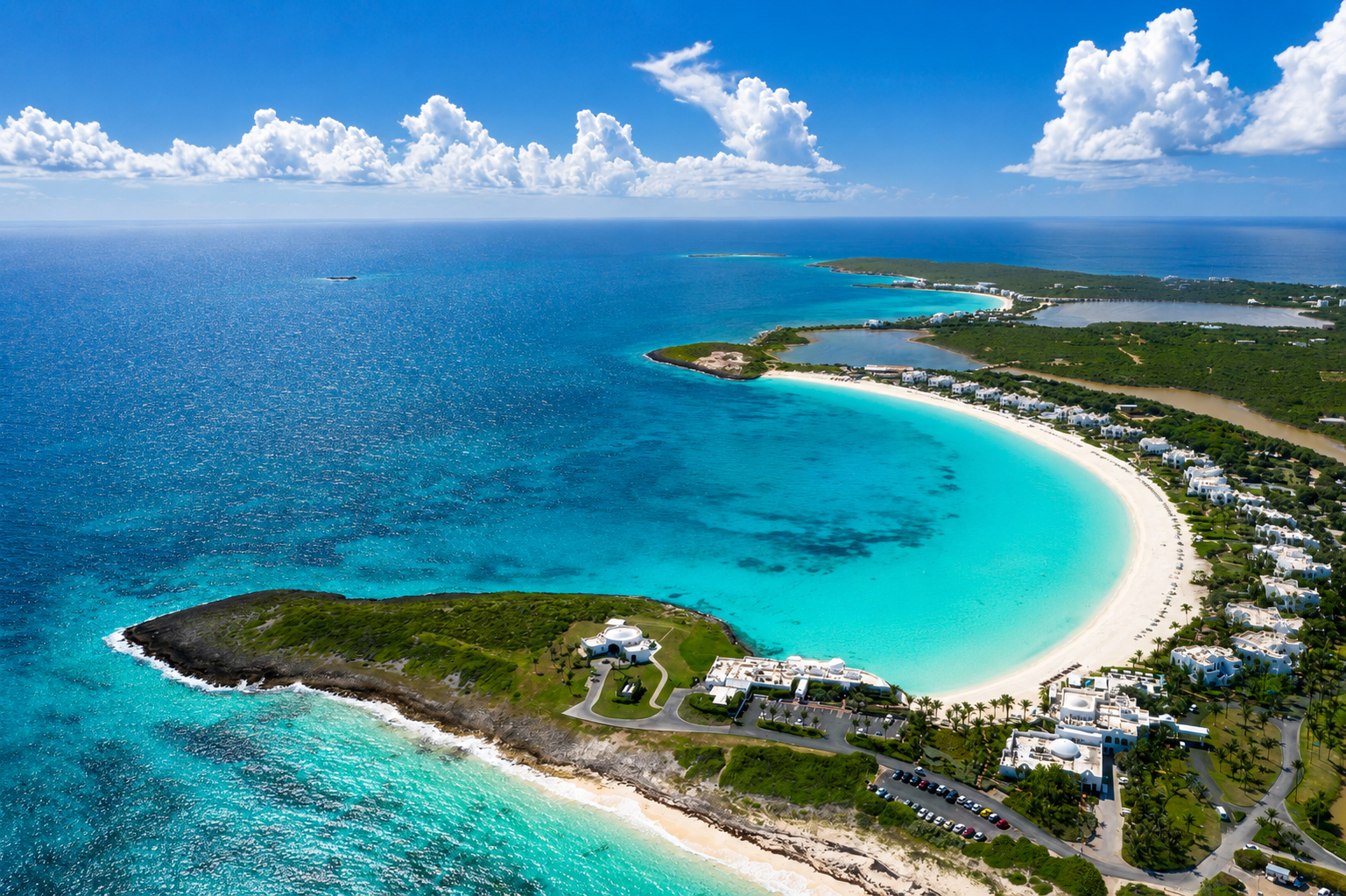 Maundays Bay — best visited between December and April
High season
Mid-December — April
This is Anguilla at its most polished: dry-season weather, calm winter light, full-service resorts, open restaurants, and the strongest choice of flights, ferries, villas, and activities. Book three to six months ahead — it is often just practical.
Shoulder season
May — August
The sweet spot for many travelers. Warmer, quieter, and rates can be noticeably softer. July and early August bring more local energy with the Summer Festival — boat racing, music, and island life beyond the resort world.
Off season
September — October
The quietest and most weather-sensitive period of the year. Hurricane risk, possible hotel closures, reduced restaurant schedules. If you come, choose flexible bookings and make sure your travel insurance includes weather-related disruption.
Is Anguilla
expensive?
Yes. Anguilla is one of the more expensive islands in the Caribbean, and pretending otherwise does not help anyone plan better.
This is not a budget island built around cheap package tourism. Anguilla has deliberately kept a lower-density, higher-quality travel style: beautiful resorts, private villas, polished restaurants, quiet beaches, and a slower kind of luxury. You feel that in the experience, and you also feel it in the prices.
But Anguilla is not expensive in the same way everywhere. The beaches are public. A simple local lunch can still be reasonable. A rental car can save money if you want to explore. Shoulder season can change the whole budget. And for families or groups, a villa can sometimes make more sense than multiple hotel rooms.
The biggest savings usually come from timing. Shoulder season rates can be much lower than peak winter, and some hotels offer packages that include breakfast, resort credit, or extras that matter once you are on island.
The best way to think about Anguilla is not "how do I make it cheap?" It is "where is the money worth spending?" Spend on location, beach access, and the atmosphere you actually want. Save by avoiding peak dates, renting a car instead of relying on taxis for every move, and choosing a few memorable meals rather than making every dinner a luxury event.
Strongly recommended,
especially for medical evacuation
Travel insurance is not currently listed as a standard entry requirement for Anguilla, so it is not mandatory. But for a real trip, especially an expensive one, it is still one of the smartest things to buy.
Anguilla is a small island. Basic medical care is available, but serious emergencies may require transfer to a larger medical center off island. That is where medical evacuation coverage becomes important. Without it, an already stressful situation can become financially brutal very quickly.
Insurance matters even more if you travel between June and November, when hurricane season can affect flights, ferries, hotels, and prepaid plans. Look for a policy that includes emergency medical care, medical evacuation, trip cancellation, trip interruption, and weather-related disruption.
For most travelers, this is not about fear. It is about protecting a trip that probably costs enough to deserve a safety net.
How to get around
the island
Anguilla looks tiny on a map, and it is. But it is not the kind of island where you want to stay trapped at one resort unless that is truly your plan.
The island is long and narrow, with beaches, restaurants, hotels, ferry terminals, and viewpoints spread across different areas. A rental car gives you the freedom to understand Anguilla properly: Shoal Bay one day, Meads Bay at sunset, Rendezvous Bay when you want space, Sandy Ground for a different mood, and a quiet beach road just because it looks promising.
 Renting a car is the best way to explore all 33 beaches
No public transport. Anguilla has no public transportation system designed for visitors. Taxis are available and useful for airport or ferry transfers, but they become expensive if you want to beach-hop, go out for lunch, come back to change, and head somewhere else for dinner.
Driving in Anguilla. Traffic drives on the left — the opposite of the U.S. A temporary Anguillian driving permit is required in addition to your home license. Most rental agencies can help issue it. Current guidance commonly lists EC$40 for a 3-day permit and EC$67 for a 3-month permit. Roads are generally manageable, but some are narrow, and goats are very much part of the island landscape.
- Rent a car for maximum flexibility — book in advance during high season
- Drive on the left
- Temporary local driving permit required (most agencies issue on-site)
- Taxis are useful for transfers, less ideal for multi-stop days
- Mokes and scooters exist, but cars are more practical for most travelers
Phones, WiFi
& electricity
Staying connected in Anguilla is usually straightforward. The island is English-speaking, major hotels have WiFi, and North American travelers do not need plug adapters.
Electricity. Anguilla runs on 110V with standard U.S.-style plugs — no adapters required for American and Canadian travelers.
Mobile & data. Mobile roaming usually works, but it can be expensive depending on your provider. An eSIM is often the easiest option because you can activate it before departure and have data ready when you arrive. This is especially useful if you are landing in St Martin first, taking the ferry, coordinating a transfer, or using maps to find your hotel or villa.
WiFi. Available at most resorts and many restaurants. Quality is usually strongest at major properties and more uneven at smaller guesthouses, beach bars, or tucked-away places — which, in Anguilla, is not always the worst thing.
Currency &
practical money tips
Anguilla's official currency is the Eastern Caribbean dollar, usually written as XCD or EC$. It is pegged to the U.S. dollar at EC$2.70 to US$1, which makes conversion fairly simple.
In practice, U.S. dollars are widely accepted across the island: hotels, restaurants, taxis, ferry services, shops, and tours. Change may be given in Eastern Caribbean dollars, especially in smaller places, so do not be surprised if your wallet becomes a mix of both currencies.
Cards & cash. Credit cards are accepted at most hotels, resorts, and established restaurants. Smaller beach bars, local lunch spots, taxis, or casual vendors may prefer cash, so keep some U.S. dollars with you. ATMs are available, especially around The Valley and main commercial areas, but do not build your whole trip around finding one at the last minute.
Tipping. Tipping follows a North American rhythm. Many restaurants and resorts may add a service charge automatically, so check the bill before adding more. If no service is included, 15–20% is standard for good service.
Is Anguilla
safe?
Anguilla is generally considered one of the calmer and safer destinations in the Caribbean for visitors. That peaceful feeling is part of its appeal: quiet roads, small communities, low-key evenings, and beaches that rarely feel chaotic. The U.S. State Department currently lists Anguilla at Level 1: Exercise normal precautions.
Use the same precautions you would anywhere you care about your passport, phone, wallet, and rental car. Do not leave valuables visible in a vehicle. Do not leave bags unattended on the beach. Use licensed taxis. Be aware at night, especially in quieter or poorly lit areas.
For many travelers, the bigger practical safety issue is not crime but weather. Hurricane season runs from June through November, with the most sensitive months usually late summer into fall. If you travel during that period, monitor forecasts, choose flexible bookings when possible, and make sure your travel insurance covers weather disruption.
Where to find
everything on the island
Anguilla sits just north of St Martin, which is why many travelers arrive through Princess Juliana International Airport on the Dutch side of St Maarten and continue by ferry or sea shuttle.
The island is about 26 kilometers long and 5 kilometers wide, small enough to drive across easily but varied enough that location matters. Meads Bay, Barnes Bay, Maundays Bay, Rendezvous Bay, Sandy Ground, The Valley, and Shoal Bay East all create a different kind of trip.
The best-known hotels, restaurants, and beaches are spread mostly across the western, northwestern, and northern parts of the island, but Anguilla rewards exploring. A rental car helps you understand how close everything is — and how different each beach can feel.
Anguilla
at a glance
| Language | English, official and spoken throughout |
| Time zone | Atlantic Standard Time, UTC-4, no daylight saving time |
| Electricity | 110V, U.S.-style plugs |
| Currency | Eastern Caribbean dollar — U.S. dollars widely accepted |
| Driving | Left side of the road, temporary local permit required |
| Status | British Overseas Territory |
| Airport code | AXA |
| Capital | The Valley |
| Main ferry terminal | Blowing Point |
| Classic ferry route | Marigot, St Martin to Blowing Point, Anguilla |
Before you book
Anguilla
Rent a car in Anguilla. Anguilla has no public transport system built for travelers, and taxis can get expensive if you want to visit several beaches, restaurants, and viewpoints in one trip. A rental car gives you the freedom to see the island properly — from Shoal Bay East to Meads Bay, Rendezvous Bay, Sandy Ground, and the quieter corners most visitors miss.
Compare prices via RentCars.com — free cancellationeSIM for Anguilla. An eSIM is one of the easiest ways to avoid roaming surprises in Anguilla, especially if you are landing in St Martin first and taking the ferry across. Activate your plan before departure, keep your regular SIM in your phone, and use data for maps, transfers, restaurant reservations, and beach-hopping without hunting for WiFi.
Get an eSIM via HolaFly — from $8Your questions
answered
February and March are excellent if you want the most reliable winter weather and the full high-season experience. May and June are often better for value, with warm beach days, fewer crowds, and a softer pace.
Yes. Anguilla is a premium Caribbean destination, especially in winter. Hotels, villas, taxis, and restaurants can be expensive, but the beaches are public, shoulder-season rates can be much lower, and renting a car can help you explore without paying for taxis every time you move.
It depends what kind of trip you want. Turks and Caicos has larger resort zones and a more developed vacation infrastructure. Anguilla feels smaller, quieter, more intimate, and more restaurant-driven. If you want polished calm, beach-hopping, and fewer crowds, Anguilla is hard to beat.
September and October are the months to approach carefully. They fall in peak hurricane season, and many hotels or restaurants may close or reduce operations. If this is your first Anguilla trip, winter or late spring is usually a better choice.
Three nights gives you a taste. Five nights feels much better. A full week is ideal if you want to explore several beaches, enjoy long lunches, take a boat trip, and still have time to do absolutely nothing.